1、 The interweaving of poetry and history
Wei Chuhou's "Twelve Scenic Poems of Shengshan" is an important work in the literary history of the Tang Dynasty in China. Among them, the poem "Su Yun Ting" depicts the scenery of Su Yun Ting on Shengshan in Kaizhou with its concise and vivid strokes, becoming an important literary material for studying the ancient city of Kaizhou in the Tang Dynasty. As the historical mother city of Kaizhou District in Chongqing, the founding time of Kaizhou Ancient City has always been a focus of academic attention. This article aims to comprehensively verify the historical fact that the ancient city of Kaizhou was founded in the Tang Dynasty through in-depth analysis of the poem "Su Yun Ting", combined with historical documents, archaeological materials, and the characteristics of Tang Dynasty urban planning, and explore its urban style, cultural connotation, and historical status.
The historical changes of the ancient city of Kaizhou have witnessed the typical development process of ancient Chinese cities. According to historical records, the ancient city of Kaizhou underwent an evolution from Hanfeng County to Kaizhou, with the Tang Dynasty being a crucial period of its development. As a famous politician and literary figure of the Tang Dynasty, Wei Chuhou was demoted to the position of governor of Kaizhou in the 13th year of the Yuanhe reign (818 AD). During his tenure, he created the "Twelve Scenic Poems of Shengshan", which are not only literary treasures but also precious historical materials for studying the history of Kaizhou's ancient city.
Through the interpretation of the imagery of "Guo" and "City" in the poem "Su Yun Ting", combined with archaeological discoveries and historical documents, this article will argue that the ancient city of Kaizhou had already formed a certain scale of urban form in the Tang Dynasty, possessing the basic conditions for being the seat of state governance, thus providing strong support for the view that the ancient city of Kaizhou was founded in the Tang Dynasty.
2、 Interpretation of the Poem "Su Yun Ting" and Speculation on the Style of Kaizhou Ancient City
2.1 Wei Chuhou and the creative background of "Twelve Scenic Poems of Shengshan"
Wei Chuhou (773-828 AD), originally named Wei Chun, changed his name to Chuhou to avoid the taboo of Emperor Xianzong. His courtesy name was Dezai, and he was born in the Wannian reign of the Jingzhao era (now Xi'an, Shaanxi). He was a famous politician and literary figure of the Tang Dynasty. In the 13th year of the Yuanhe reign of the Tang Dynasty (818 AD), Wei Chuhou was demoted from the position of a successful candidate to the position of governor of Kaizhou. During his tenure in Kaizhou, he wrote the "Twelve Scenic Poems of Shengshan", including "Su Yun Ting", "Hidden Moon Xiu", "Mei Xi", "Tao Wu", "Cha Ling", "Zhu Ya" and other 12 scenic poems. These poems not only depict the natural scenery of Mount Sheng in Kaizhou, but also reflect the urban style and cultural environment of the old city of Kaizhou at that time.
Wei Chuhou's "Twelve Scenic Poems of Shengshan" attracted widespread attention at that time. Famous poets such as Bai Juyi, Zhang Ji, and Yuan Zhen wrote and sang poems, forming a collection of poems, which was prefaced by Han Yu, the head of the "Eight Masters of Tang and Song Dynasties". Han Yu commented in "Preface to the Twelve Poems of Shengshan by Wei Shi in Kaizhou": "Wei Hou read the Six Arts to explore the meanings of Duke Zhou and Confucius, and was also skilled in composing poetry. He can be called a Confucian." The widespread dissemination of these poems made Shengshan and Kaizhou famous, becoming a place that literati and scholars longed for at that time.
2.2 Text Analysis of the Poem "Su Yun Ting"
The poem 'Su Yun Ting' is one of the representative works in the 'Twelve Scenic Poems of Shengshan'. The entire poem is as follows:
Rain mixed with flying danger, the sky opened and the window opened in the morning.
Qi Ping Lian Guo Liu, lead around Baocheng River. "
This poem depicts the scenery of Suyun Pavilion and the surrounding natural environment in concise language. The two sentences' Rain flies together in dangerous buildings, the sky uncovers the morning window 'depict the scene of raindrops dancing on the dangerous buildings, showing the towering and steep nature of the Su Yun Pavilion; After the rain, the sky is clear and bright, and the scene of the morning window opening presents a fresh and peaceful beauty.
The last two sentences, 'Leveling with Guo Liu and winding around Baocheng River,' further depict the scenery around Suyun Pavilion. Guo "refers to the wall surrounding the city outside the city, while" Qi Ping Lian Guo Liu "depicts rows of green willows lining the city wall, forming a neat barrier; The scene of the river surrounding the city walls is vividly depicted in the poem 'Embracing the City River', showcasing the geographical feature of the ancient city of Kaizhou being surrounded by the river water.
2.3 Inferring the location and style of the ancient city of Kaizhou from poetry
From the description in the poem 'Su Yun Ting', we can infer the location and characteristics of the ancient city of Kaizhou:
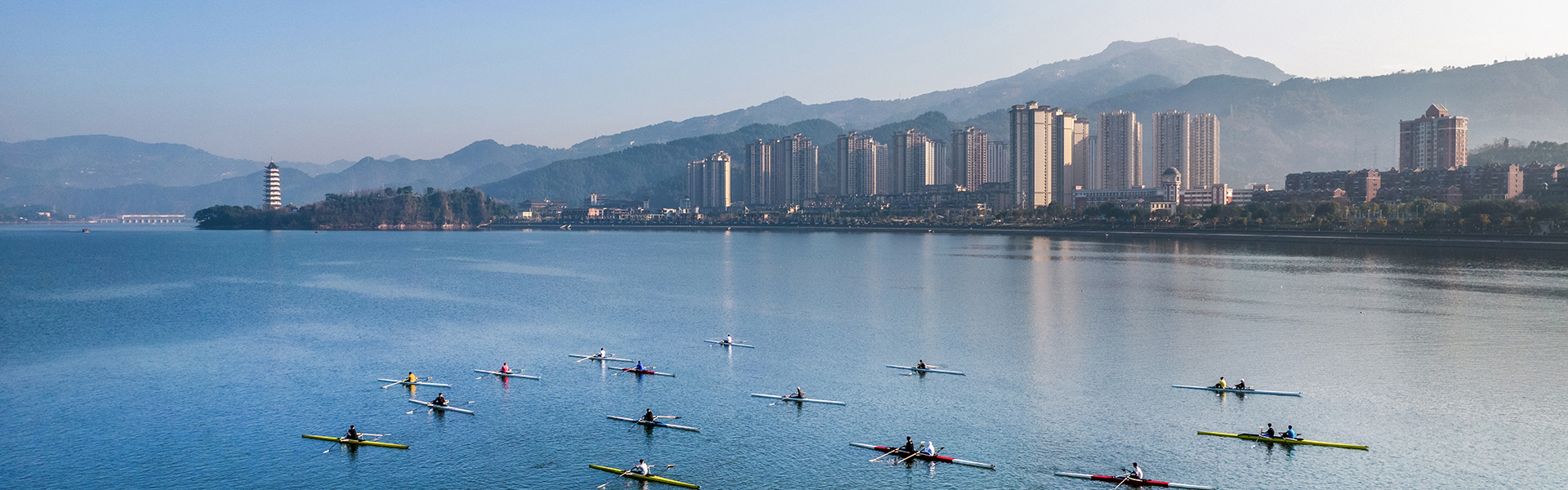
1. Geographical location: The line "with the river surrounding the city" in the poem indicates that the ancient city of Kaizhou is located in the area surrounded by the river. Based on historical and geographical data, the ancient city of Kaizhou is located at the confluence of the East River and the South River. These two rivers converge near the ancient city to form the Pengxi River, which later flows into the Yangtze River. The geographical location where the two rivers intersect provides ample water sources and convenient transportation conditions for the city, which also conforms to the basic principles of ancient Chinese city site selection.
1. Urban form: The "Guo" in "Qi Ping Lian Guo Liu" refers to the outer city, indicating that the old city of Kaizhou has a distinction between inner and outer cities. Tang Dynasty cities usually had strict planning, with the inner city serving as the administrative center and the outer city as residential and commercial areas. The scene depicted in the poem of willow trees connected to the city walls showcases the overall layout and greenery of the city.
1. Architectural features: The "dangerous masonry" in "Rain and Flying Dangerous Masonry" refers to towering steps, implying that the Suyun Pavilion is located at a high place, possibly on Shengshan, overlooking the entire city. This layout of building observation buildings at high places not only conforms to the characteristics of traditional Chinese garden architecture, but also reflects the concept of combining landscape and practicality in Tang Dynasty urban planning.
1. Natural environment: The rain and river scenery depicted in the poem showcase the beautiful natural environment around the ancient city of Kaizhou. Kaizhou is located on the eastern edge of the Sichuan Basin, with a humid climate and abundant precipitation. This natural environment provides favorable conditions for the development of the city and shapes its unique urban style.
Through the interpretation of the poem "Su Yun Ting", we can preliminarily outline the basic outline of the ancient city of Kaizhou in the Tang Dynasty: a city located at the confluence of two rivers, surrounded by river water, with a distinction between inner and outer cities. The green trees on the edge of the city wall provide shade, the buildings inside the city are staggered, and the mountains and waters outside the city are interdependent, forming a beautiful picture of "the city in the water, the water in the city".
3、 The historical evolution of the ancient city of Kaizhou and the basis for its establishment in the Tang Dynasty
3.1 Historical evolution of the former city of Kaizhou
The history of the ancient city of Kaizhou can be traced back to the 21st year of Jian'an in the Eastern Han Dynasty (216 AD). At that time, Liu Bei, in order to consolidate the Shu Han regime, separated three salt producing areas in Quren County and established them as separate counties. Among them, the area where Wentangjing is located in the northwest was separated and established as Hanfeng County (now Kaizhou). According to research, Liu Bei, the founder of Shu Han, built Hanfeng County on the south bank of Pengxi River. The ancient city site of Hanfeng County is located in the area of Longwang Temple on Binhu East Road today. This is the first time a city has been built in Kaifeng and also the earliest administrative system in Kaifeng.
Since then, the ancient city of Kaizhou has undergone multiple changes:
During the Wei, Jin, Southern and Northern Dynasties period, Hanfeng County was successively renamed Yongning County and Shengshan County, and its administrative divisions were also adjusted. In the second year of Emperor Fei of Western Wei (553 AD), Kaizhou was established, with its capital located in Shabachang, northeast of Kaijiang County, Sichuan Province. It governed three commanderies: Zhou'an, Wan'an, and Jianghui. During the Northern Zhou Dynasty, the administrative center of Kaizhou was relocated to Hanfeng County (now northwest of Kaizhou District, Chongqing).
1. Sui Dynasty: In the third year of the Kaihuang reign (583 AD), the county was changed to a prefecture and directly governed by the county. In the 18th year of the Kaihuang reign (598 AD), Yongning County was renamed Shengshan County. In the second year of Daye (606 AD), Kaizhou was abolished, and in the seventh year of Daye (611 AD), Xinpu County was relocated. In the second year of Yining (618 AD), Wanzhou was established in Shengshan County, with the overall jurisdiction of Shengshan, Wanshi, Xinpu, and Xiliu counties.
1. Tang Dynasty: In the first year of the Wude reign of the Tang Dynasty (618 AD), Wanzhou was renamed Kaizhou, which governed three counties: Kaijiang, Wansui, and Xinpu, and was under the jurisdiction of Shannan West Road (with its capital in present-day Hanzhong, Shaanxi Province). In the first year of the Zhenguan era (627 AD), Xiliu County was merged into Shengshan County. In the first year of Tianbao (742 AD), Kaizhou was renamed Shengshan Commandery. In the first year of Qianyuan (758 AD), it was restored to Kaizhou. In the first year of Guangde (763 AD), Shengshan County was renamed Kaijiang County, and Kaizhou governed Kaijiang, Xinpu, and Wansui (renamed Wanshi) counties.
During the Song, Yuan, Ming, and Qing dynasties, Kaizhou was under the jurisdiction of Kuizhou Road; In the Yuan Dynasty, provinces and counties were incorporated into prefectures; In the sixth year of the Hongwu reign of the Ming Dynasty (1373), the prefecture was downgraded to a county, and the name of the county was established from then on; The Qing Dynasty continued the Ming system; In 1914, it belonged to Dongchuan Road; After 1949, it belonged to the Wanxian Special Zone of Sichuan Province; After being directly administered by Chongqing in 1997, it belonged to Chongqing City; In June 2016, Kaixian was upgraded from a county to a district and renamed Kaizhou District.
4、 The founding basis of the ancient city of Kaizhou in the Tang Dynasty
The basis for the founding of the ancient city of Kaizhou in the Tang Dynasty mainly includes the following aspects:
1. Historical records: "The Geography of the New Book of Tang" records: "Shengshan Commandery in Kaizhou, originally known as Wanshi Commandery, was separated from Shengshan and Xinpu in Badong Commandery in the second year of Yining, and Wanshi and Xiliu in Tongchuan Commandery were established. It was renamed in the first year of Tianbao." This indicates that Kaizhou was officially established in the first year of Wude in the Tang Dynasty (618 AD), with its capital in Shengshan County (now Kaizhou District, Chongqing), marking the formal establishment of Kaizhou's former city as the capital.
1. Archaeological discoveries: From 2006 to 2008, archaeologists conducted three archaeological excavations at the ancient city site of Kaixian to support the construction of the Three Gorges Reservoir area. The archaeological report shows that the Kaixian Ancient City Site mainly includes relics from several periods including the Eastern Han Dynasty, Tang Dynasty, Song Dynasty, Yuan Dynasty, Ming Dynasty, Qing Dynasty, and the Republic of China. Although there are relatively few relics from the Tang Dynasty, with only a small number of ceramic fragments found, this indicates that humans were already active in this area during the Tang Dynasty.
1. Evidence of urban migration: According to historical records, in the first year of Tang Wude (618 AD), Emperor Gaozu of Tang, Li Yuan, relocated Hanfeng County to the intersection of Donghe and Nanhe rivers (now the ancient underwater city), which was the second transformation of Kaizhou city. Li Yuan implemented the Daozhou County system and relocated the Hanfeng County seat to a place that had already become a city as the location of the state seat and county seat. The state and county were located in the same city and had a prominent position.
1. Geographical environment analysis: The ancient city of Kaizhou is located at the confluence of the East River and the South River, and is the source of the Xiaojiang River, a first level tributary of the Yangtze River, formerly known as Pengxiyuan. Traveling upstream along the Donghe River leads to the salt producing town of Wentangjing, while traveling upstream along the Nanhe River leads to the western material distribution center of Linjiang City (Linjiang Town). Traveling downstream along the Xiaojiang River connects to the Yangtze River, making transportation very convenient. This advantageous geographical location provided favorable conditions for the establishment of the ancient city of Kaizhou during the Tang Dynasty.
1. Urban development scale: From the characteristics of the form, scale, and tomb bricks of the Han tomb KXG VII M1 discovered in archaeology, it reflects that the economic and cultural development pace of this region was relatively consistent with that of the Chongqing area in the Han Dynasty, which can explain from another perspective that the ancient city of Kaixian had already developed on a considerable scale at that time. The reason why the capital was moved to the ancient city of Kaixian in the first year of Tang Wude's reign may not only be due to its location at the confluence of the East River and the South River, where the terrain is flat and transportation is convenient, which is conducive to the development of the city, but also because since the Han Dynasty, the population, politics, economy, and settlement scale of this area may have developed to a certain extent, possessing the basic conditions for being a county capital.
Based on the above evidence, it can be confirmed that Kaizhou Ancient City was officially established as the capital of the state in the first year of the Tang Dynasty's Wude era (618 AD), marking the beginning of Kaizhou Ancient City as a complete city. Although its predecessor can be traced back to Hanfeng County in the Eastern Han Dynasty, as the capital of Kaizhou (a state-level administrative unit), it began in the Tang Dynasty.
5、 The Urban Planning and Architectural Features of Kaizhou Ancient City in the Tang Dynasty
4.1 General characteristics of urban planning in the Tang Dynasty
The Tang Dynasty was an important period for the development of urban planning in ancient China, forming a relatively mature urban planning system. Understanding the general characteristics of urban planning in the Tang Dynasty can help us understand the planning layout of the ancient city of Kaizhou.
1. Lifang system: During the Tang Dynasty, cities generally adopted the Lifang system, which divided the city into several enclosed Lifang areas. Each Lifang area was surrounded by walls, had gates, and implemented a curfew system. This kind of planning is beneficial for urban management and public security maintenance.
1. Axis symmetry: Tang Dynasty cities often adopted an axis symmetry layout, with palaces or official offices as the center and radiating outwards. Chang'an City is a typical representative, with Zhuque Avenue as the central axis, dividing the city into two parts, east and west, with a rigorous layout and clear functional zoning.
1. Functional zoning: During the Tang Dynasty, cities were generally divided into functional areas such as palace areas, government offices, residential areas, commercial areas, and religious areas. Palace and official districts are mostly located in the city center or high places, residential and commercial areas are distributed around, and religious buildings are distributed in different locations of the city according to their beliefs.
1. Road system: The urban road system in the Tang Dynasty was well-developed, with a clear three-level system of main roads, secondary roads, and branch roads, and road widths varied according to different levels. The main roads are usually oriented in a north-south and east-west direction, forming a chessboard layout.
1. Water system utilization: Tang Dynasty cities attached great importance to the utilization of water systems, which were used for urban water supply and drainage, as well as for transportation and landscape creation. The Yong'an Canal, Qingming Canal, Longshou Canal and other water systems in Chang'an City run through the entire city, meeting the urban water demand and adding to the urban landscape.
1. City walls and gates: During the Tang Dynasty, cities commonly had city walls built as defensive fortifications. The city walls are mostly made of rammed earth, covered with bricks, and equipped with defensive facilities such as city gates, city towers, corner towers, and horse faces. The city gate is the entrance and exit of the city, usually equipped with a moat to enhance defense capabilities.
4.2 Urban Planning Characteristics of Kaizhou Ancient City
Although the specific planning of the ancient city of Kaizhou cannot be fully verified, based on historical documents and archaeological discoveries, we can speculate that its urban planning has the following characteristics:
1. Landscape urban pattern: The ancient city of Kaizhou is located at the intersection of the East River and the South River, forming a unique landscape urban pattern. The city is surrounded by two rivers as natural moats, and Shengshan is the city's backyard. The Daqi Mountain above Shengshan was already an important granary in the Han Dynasty, and even more so in the Tang Dynasty. The geographical environment of "surrounded by mountains on three sides and two rivers flowing between" determines that the planning of the ancient city of Kaizhou must be closely integrated with natural mountains and rivers.
1. Clear functional zoning: As the seat of state governance, the internal functional zoning of the former city of Kaizhou should be relatively clear. According to historical records, there are government offices (state offices, county offices), residential areas, commercial areas, religious areas, etc. within the city. Among them, the state government office is located in the center or high places of the city, reflecting its position as a political center; Commercial areas may be located in areas with convenient transportation, such as near city gates or rivers; Residential areas are differentiated based on residents' identity and occupation.
1. Road system: The road system in the ancient city of Kaizhou may be limited by terrain and not as orderly as Chang'an, but the main roads should still be relatively clear. According to literature records, there is a saying in the ancient city of Kaizhou that there are "nine wells and eighteen alleys", indicating that the streets and alleys in the city are crisscrossed and the layout is relatively complex. These streets and alleys are not only channels for residents to travel, but also places for commercial activities.
1. Water system utilization: The ancient city of Kaizhou fully utilizes the water resources of the East River and South River, serving as a moat to enhance defense capabilities; On the other hand, it is used for urban water supply and drainage. In addition, there may be water conservancy facilities such as wells and ponds in the city to meet the daily needs of residents.
1. City Wall and Gate: According to the description of the characters "Guo" and "Cheng" in Wei Chuhou's poem "Su Yun Ting", the ancient city of Kaizhou may have had a city wall built in the Tang Dynasty. But the literature records are unknown, and archaeological data is needed for further verification. According to later records, the ancient city of Kaizhou was divided into two parts: the inner and outer cities. The outer city walls were built along the river, which not only considered defense functions but also fully utilized the natural terrain.
4.3 Architectural Features of Kaizhou Ancient City
Although most of the buildings in the ancient city of Kaizhou no longer exist, we can infer their architectural features through historical documents, archaeological discoveries, and the poem "Su Yun Ting"
1. Official buildings: As the seat of state governance, the official buildings in the former city of Kaizhou should be relatively magnificent. State offices are usually located in the city center or high places, reflecting political authority. Official buildings often adopt a symmetrical layout along the central axis, with the main building being the lobby, used for handling government affairs; The back hall serves as the office and residential area for officials; On both sides are compartments used for storing documents and other items.
1. Religious buildings: There are numerous religious buildings in the ancient city of Kaizhou, such as Dajue Temple and Yu Palace. Dajue Temple was first built in the Tang Dynasty and is a famous Buddhist temple in Kaizhou. During his tenure as governor of Kaizhou, Wei Chuhou repaired it. These religious buildings are not only places for religious activities, but also important venues for urban culture and social activities.
1. Residential buildings: The residential buildings in the ancient city of Kaizhou may be mainly made of wooden structures, with roofs made of hanging or gable mountains

汉丰湖度假区小程序

汉丰湖度假区智慧导览

汉丰湖度假区公众号
 Service Hotline
 official account
 Voice guided tour